

Table of Contents
- Why Most Healthy Habits Fail Within Weeks
- The Habit Loop: Cue, Routine, Reward
- Start Small: Setting Attainable Goals That Actually Work
- Habit Stacking Examples: Attach New Behaviors to Existing Routines
- How Long Does It Take to Form a Habit? Real Timelines
- Best Tools for Tracking Wellness Habits
- Designing Your Environment and Managing Digital Triggers
- Psychological Barriers and How Social Support Drives Healthy Habits
- Frequently Asked Questions
Last Updated: September 17, 2026
Why Most Healthy Habits Fail Within Weeks
Most people who try to build lasting healthy habits fail because they aim too high, too fast. The enthusiasm that fuels week one rarely survives week three, and the reason is biological, not moral. This guide from XTRAORDINARY ASSOCIATES breaks down a practical, step-by-step approach to how to build lasting healthy habits that survive contact with real life.
A habit loop is the neurological cycle of cue, routine, and reward that drives automatic behavior. Understanding this cycle is the foundation of behavior change, because every lasting routine you've ever kept runs on it whether you noticed or not.
A common mistake is treating motivation as the engine. It isn't. Motivation is the spark; the habit loop is the machinery. Skip the machinery and you're relying on a feeling that fades by Thursday.
The Habit Loop: Cue, Routine, Reward
Every habit, good or bad, follows the same three-part sequence. A cue triggers the behavior, the routine is the behavior itself, and the reward is what your brain gets out of it. Change any one link and the loop weakens.
For a healthy habit to stick, it needs a reliable cue, a routine small enough to repeat, and a reward that arrives quickly enough to register. Many people nail the routine and neglect the other two, then wonder why the habit collapses.
Start Small: Setting Attainable Goals That Actually Work
Attainable goals are the difference between a routine that survives and one that dies in week two. The rule is simple: start with a version of the habit so small it feels almost too easy.
Want to drink more water? Start with one glass after waking. Want to walk daily? Start with five minutes.
Using SMART Goals to Shape Your Daily Regimen
SMART goals are targets that are Specific, Measurable, Achievable, Relevant, and Time-bound. A vague goal like "get healthier" gives your brain nothing to act on. A SMART version does.
| Element | Weak Goal | SMART Goal |
|---|---|---|
| Specific | Get fit | Walk 10 minutes after lunch |
| Measurable | Eat better | Add one vegetable to dinner |
| Achievable | Run a marathon | Jog 1 mile, 3x per week |
| Relevant | Be healthier | Improve daily energy levels |
| Time-bound | Eventually | Every weekday for 4 weeks |
Habit Stacking Examples: Attach New Behaviors to Existing Routines
Habit stacking examples work because they borrow an existing cue instead of asking you to build one from scratch. You attach the new behavior to something you already do without thinking.
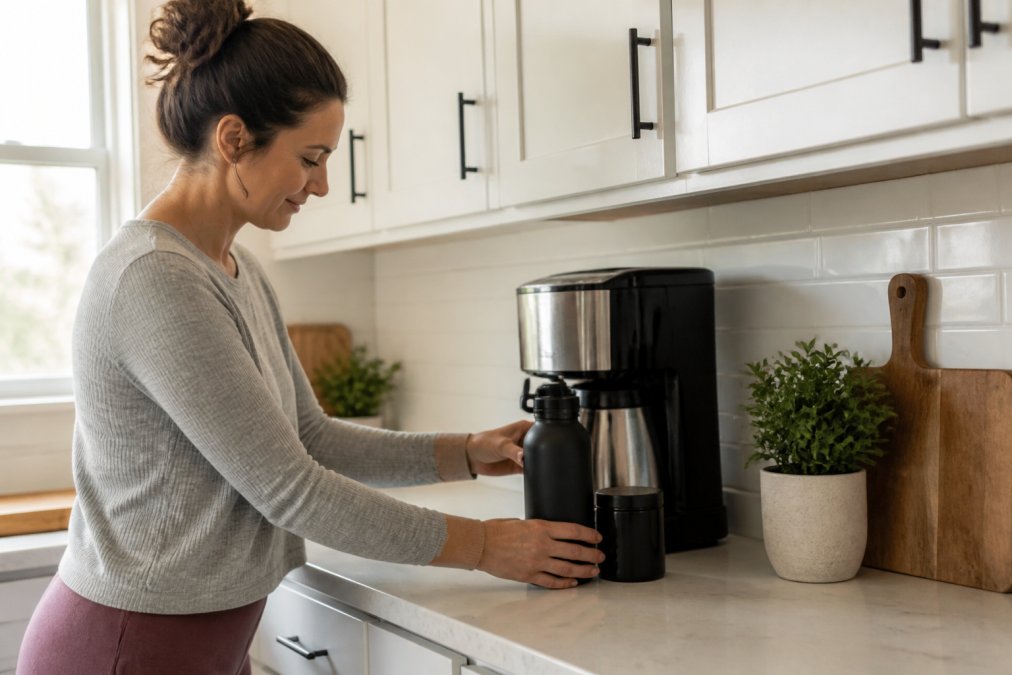
A few that hold up in practice:
- After I pour my morning coffee, I take my daily supplement with a full glass of water.
- After I brush my teeth, I do two minutes of stretching.
- After I sit down at my desk, I write down my top three priorities.
- After I finish dinner, I take a short walk around the block.
How Long Does It Take to Form a Habit? Real Timelines
The honest answer to how long does it take to form a habit is that it varies by person and by behavior. Simple routines can feel automatic in a few weeks; complex ones can take months. There is no universal number, and anyone selling one is guessing.
Why Consistency Beats Perfection
Consistency outperforms perfection because habits are built through repetition, not flawless execution. A mediocre version of the habit done today beats a perfect version you'll do "when things calm down."
Best Tools for Tracking Wellness Habits
The best tools for tracking wellness habits are the ones you'll actually open daily. A paper calendar on the fridge often beats an app you forget exists. The tool matters far less than the feedback loop it creates, but the format of that feedback loop changes how well it works.
- Binary trackers (a checkbox per day). Fastest to fill in, easiest to keep up with, and best for habits where the goal is simply "did it or didn't I." The downside is they can't capture partial progress, so a five-minute walk and a five-mile run look identical.
- Quantity trackers (minutes, ounces, pages, reps). Better for habits with a measurable dose, like water intake or walking minutes. They surface trends a checkbox hides, but they invite the all-or-nothing trap when you fall short of a target number.
- Streak trackers (consecutive days). Powerful motivators because loss aversion kicks in, people hate breaking a chain. The risk is that one missed day can trigger abandonment rather than a reset, which is exactly the failure mode this guide warns about elsewhere.
A few concrete options that map to those formats:
- A printed monthly calendar with a marker dot per day (binary, zero friction, lives on the fridge)
- A notes app with a recurring daily reminder and a running list (quantity, always in your pocket)
- A dedicated habit app with streaks and push reminders (streak, highest motivation but highest abandonment risk)
- A shared spreadsheet with a partner or friend (binary or quantity, adds a social layer)
Designing Your Environment and Managing Digital Triggers
Environment design means arranging your surroundings so the healthy choice is the easy choice. Willpower is unreliable; a well-designed environment doesn't need it. Put the fruit on the counter and the chips out of reach.
Psychological Barriers and How Social Support Drives Healthy Habits
Psychological barriers, not lack of information, are what stall most people. Fear of failure, perfectionism, and the belief that change must be dramatic all quietly sabotage progress. Naming the barrier is the first step to moving past it, and the single most common barrier has a name.
All-or-Nothing Thinking Is the Habit Killer
All-or-nothing thinking is the cognitive distortion that treats any deviation from a plan as total failure. One missed workout becomes "I'm not a workout person." One slip on a diet becomes "I've ruined it, might as well finish the pint." The behavior itself is minor; the story attached to it is what ends the habit.
Habits Spread Through Social Networks
Social support isn't just cheerleading, habits are contagious. People tend to adopt the exercise, eating, and drinking patterns of the people they spend the most time with, and the effect runs in both directions. If your closest circle walks after dinner, you're more likely to walk after dinner. If your closest circle orders takeout most nights, that becomes your default too.
- Modeling. Seeing someone else do the behavior lowers your perceived effort and normalizes it.
- Commitment. Telling someone your plan creates a small social cost to quitting.
- Environment. Shared routines put the healthy cue directly in your path instead of relying on you to remember it.
Frequently Asked Questions
What is the 3-3-3 rule for habits?
The 3-3-3 rule breaks habit building into three phases: three days to notice the change, three weeks to see visible progress, and three months to make it automatic. It works because it sets realistic checkpoints instead of expecting instant results. Use each phase to review what is working, adjust your cues, and keep your daily regimen small enough to repeat. The rule pairs well with habit stacking, since attaching a new behavior to an existing routine makes each phase easier to sustain.
How long does it take to form a habit, really?
Research on habit formation suggests it takes anywhere from about 18 to 254 days for a behavior to feel automatic, with many people landing around 66 days. The exact number depends on how complex the habit is and how often you repeat it. Simple actions like drinking water after waking up become automatic faster than a full workout routine. Focus on repetition and consistency rather than counting days, and track your progress so you can see incremental gains over time.
Why do most healthy habits fail after a few weeks?
Most habits fail because people start too big, rely on willpower alone, and have no system for tracking progress. When motivation drops, the behavior disappears. Building lasting healthy habits means shrinking the action until it is almost effortless, tying it to an existing trigger, and designing your environment so the healthy choice is the easy one. Adding accountability through a friend, app, or coach also raises long-term adherence significantly.
What are the best tools for tracking wellness habits?
The best tools are the ones you will actually open every day. Simple paper habit trackers work well for people who like a visual streak. Habit apps on your phone offer reminders, streaks, and progress charts. Wearables can track sleep, movement, and energy levels automatically. Whichever you choose, keep the metric narrow, maybe two or three habits at most, and review your data weekly to spot patterns and adjust your routine.
Building lasting healthy habits isn't about intensity. It's about a small routine, a reliable cue, a quick reward, and a support system that keeps you honest when motivation dips. XTRAORDINARY ASSOCIATES offers clean, thoughtfully formulated supplements like Black Seed Oil and Vitamin D3+K2 to support energy, immune health, and overall vitality as part of a consistent daily routine. Get started with XTRAORDINARY ASSOCIATES and build a wellness regimen you can actually keep.